Reference mapping — label transfer (R Seurat vs Truecell)
A side-by-side port of Seurat's reference mapping vignette
on the pancreatic-islet dataset (panc8): ~14,900 human islet cells profiled
across five technologies (CEL-seq, CEL-seq2, SMART-seq2, Fluidigm C1, inDrop).
Each technology is its own batch with its own capture chemistry, so the same
cell type looks measurably different from one to the next — which is exactly what
makes cross-technology annotation transfer a real test.
The task reference mapping solves: you have an annotated atlas you trust (the reference) and a new, unlabelled dataset (the query); borrow the atlas's labels to annotate the query — without ever moving or re-clustering the reference. Unlike integration, which corrects several datasets onto each other, mapping is deliberately asymmetric: the reference is fixed, the query is projected into the reference's own PCA, and labels are carried across scored mutual-nearest-neighbour anchors. Truecell ships the whole workflow, and this walkthrough runs it against its Seurat reference on identical counts:
find_transfer_anchors↔FindTransferAnchors(reduction="pcaproject")— project the query into the reference's PCA and find scored anchors.transfer_data↔TransferData— a per-query-cell weighted vote over the reference labels (predicted.id+prediction.score.*).map_query/project_umap↔MapQuery/ProjectUMAP— place the query in the reference's own UMAP, so the new cells land on the atlas you already know how to read.
Why this tutorial exists. The whole reference-mapping stack (
find_transfer_anchors/transfer_data/map_query/project_umap) landed with only syntheticdefault_rngfixtures for tests — two cell types, a planted batch block, balanced sizes. This is the first time it meets a real atlas with thirteen cell types (several of them rare), genuine cross-technology batch structure, and a Seurat reference to match. The projected embedding is not coordinate-comparable across tools (irlba-vs-scikit-learn PCA sign, uwot-vs-umap-learn transform) — but the transferred labels are a robust weighted argmax, so they compare per cell: does truecell assign each query cell the samepredicted.idas Seurat, and does each tool recover the query's true cell type.
Reference and query — one technology each
Seurat's vignette builds a multi-technology integrated reference. This tutorial deliberately uses a single-technology reference and a single-technology query, for two reasons: it isolates the label-transfer machinery from the integration machinery the integration tutorial already checks, and it is still a genuine cross-chemistry transfer.
Reference: celseq2   2,285 cells   (tag-based CEL-seq2)     — all 13 cell types
Query:     smartseq2 2,394 cells   (full-length SMART-seq2) — all 13 cell types
Both technologies carry every one of the 13 annotated cell types, so the transfer
has a fair target for each. The query's own celltype labels ship with the data
but are held back as ground truth — never fed to the transfer — so the result
can be scored directly for accuracy, not merely for agreement with R.
panc8 is a curated SeuratData object with no clean raw source, so both languages
read the same counts, exported once from R by tutorials/export_seuratdata.R
into a 10x-style matrix folder (byte-identical input and cell order, the same
discipline the integration tutorial gets from the same
bridge).
Step 1 · Load, split by technology, prep on one shared basis
Both objects are built from one gene universe (split from a single object, so the
reference and query share an identical feature set) and prepped the standard way.
One wrinkle keeps the cross-tool comparison fair, exactly as in the integration and
Mixscape tutorials: both tools use the same variable features. The Python run
writes the 2,000 reference HVGs it selected to figures_refmap/hvg_features.txt,
and the R script reads them back — so the only divergences left are the genuinely
method-level ones (PCA numerics, the anchor/weight kernels, kNN ties). The query
is scaled on the reference's HVGs so the projection lines up gene-for-gene.
Step 2 · Transfer anchors and labels
FindTransferAnchors(reduction="pcaproject") projects the query through the
reference's PCA loadings — the principal axes are learned once on the reference
and the query is pushed through the same map, so batch-specific structure the
reference never saw simply lands nowhere. TransferData then turns the scored
anchors into a per-query-cell weighted vote over the reference's celltype.
Both tools find a healthy anchor set on the shared HVG basis (truecell 3,561
anchors) and transfer with high confidence — mean prediction.score.max 0.988
(truecell) vs 0.988 (Seurat).
Step 3 · Score the transfer
Because the query's true celltype is known, the headline metric is plain
accuracy — the fraction of query cells whose transferred predicted.id
matches the truth — read per cell type. The Truecell result:
| cell type | support | recall ↑ |
|---|---|---|
| alpha | 1,008 | 0.989 |
| ductal | 444 | 0.996 |
| beta | 308 | 0.990 |
| gamma | 213 | 0.991 |
| acinar | 188 | 1.000 |
| delta | 127 | 0.984 |
| activated_stellate | 55 | 1.000 |
| endothelial | 21 | 1.000 |
| epsilon | 8 | 0.500 |
| macrophage | 7 | 0.857 |
| mast | 7 | 1.000 |
| quiescent_stellate | 6 | 0.000 |
| schwann | 2 | 0.000 |
| overall | 2,394 | 0.986 |
2,361 of 2,394 query cells (98.6%) are annotated correctly. Every abundant cell type is recovered at ≥98%; the whole error budget is the handful of rare types (epsilon, macrophage, quiescent_stellate, schwann) for which the 2,285-cell single-technology reference simply carries too few examples to anchor reliably — the macro-averaged recall (0.79, every class weighted equally) is what exposes that tail. This is the honest limit of a small single-tech reference, not a defect: Seurat's transfer stumbles on exactly the same rare types.
| R — reference atlas (celseq2) | Truecell — reference atlas (celseq2) |
|---|---|
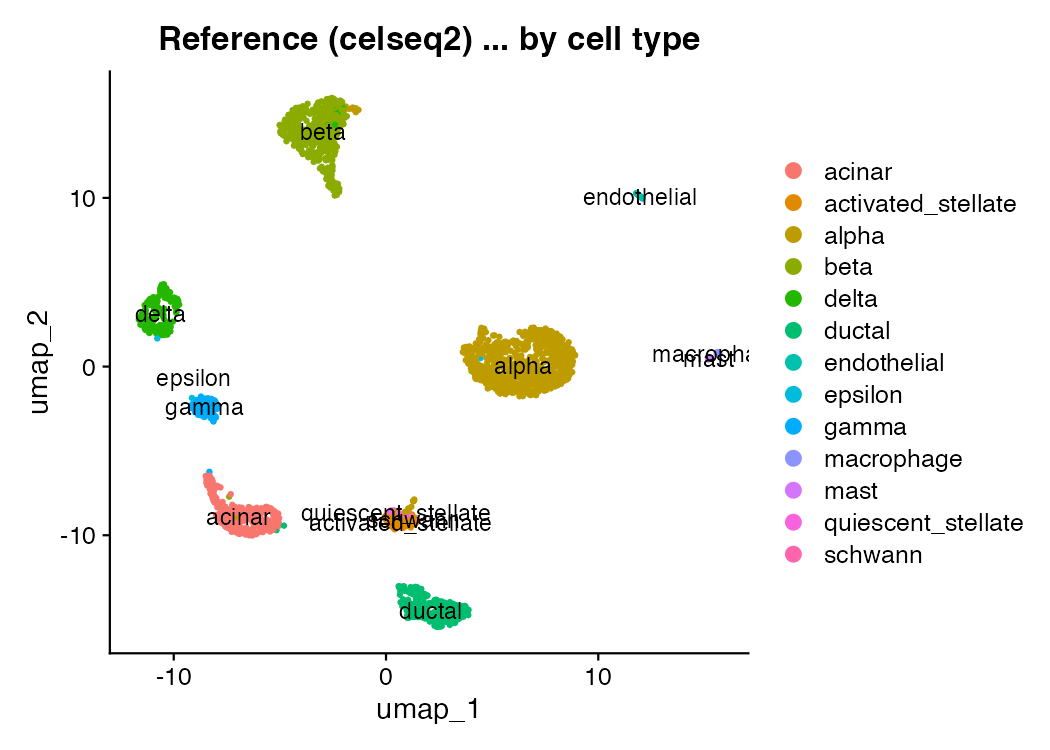 |
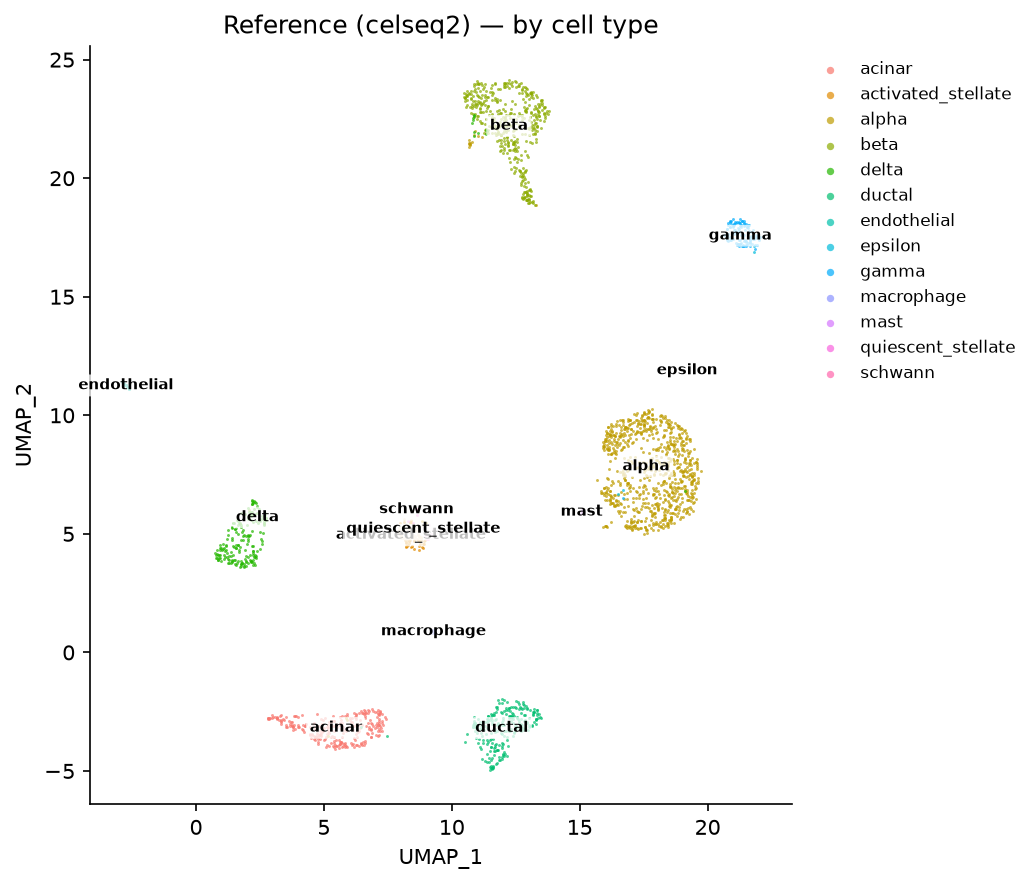 |
map_query / project_umap place the query into the reference's fitted UMAP, so
the SMART-seq2 cells land on the CEL-seq2 atlas. Coloured by the transferred label
(left) and by the held-out truth (right), the two agree wherever the transfer
succeeded — the projection is a visual read of the accuracy above:
| Truecell — query projected, predicted label | Truecell — query projected, true label |
|---|---|
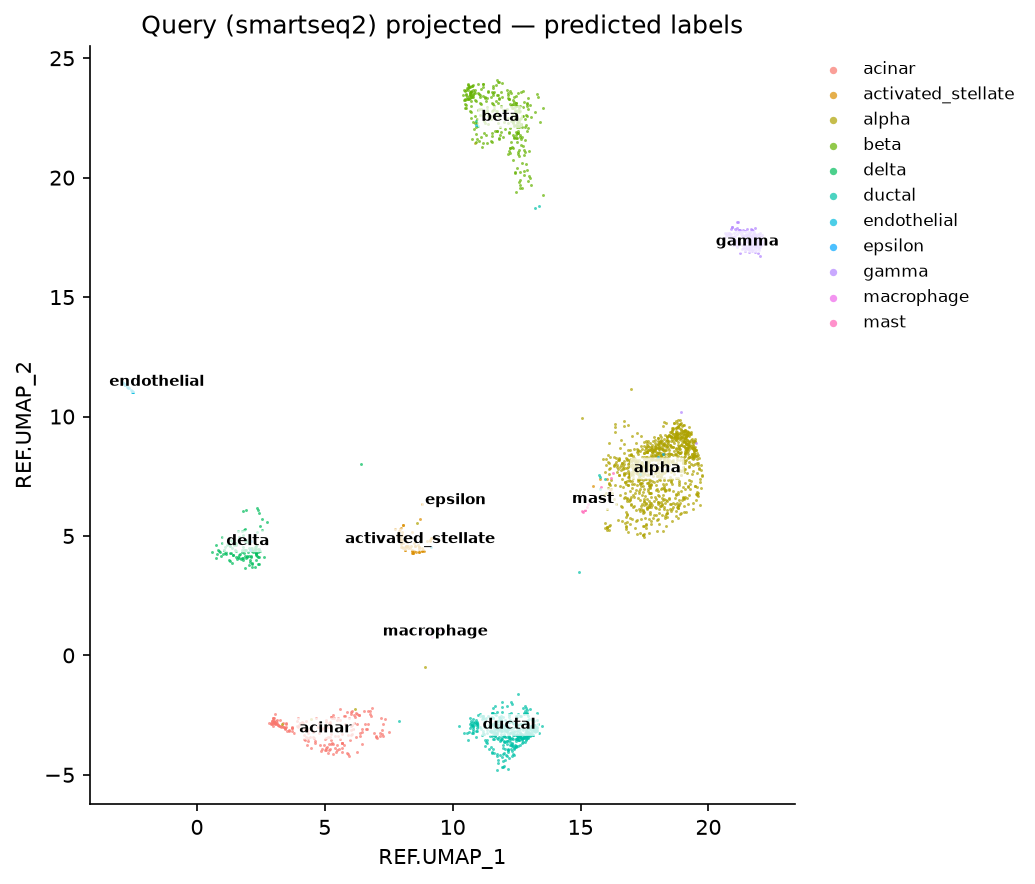 |
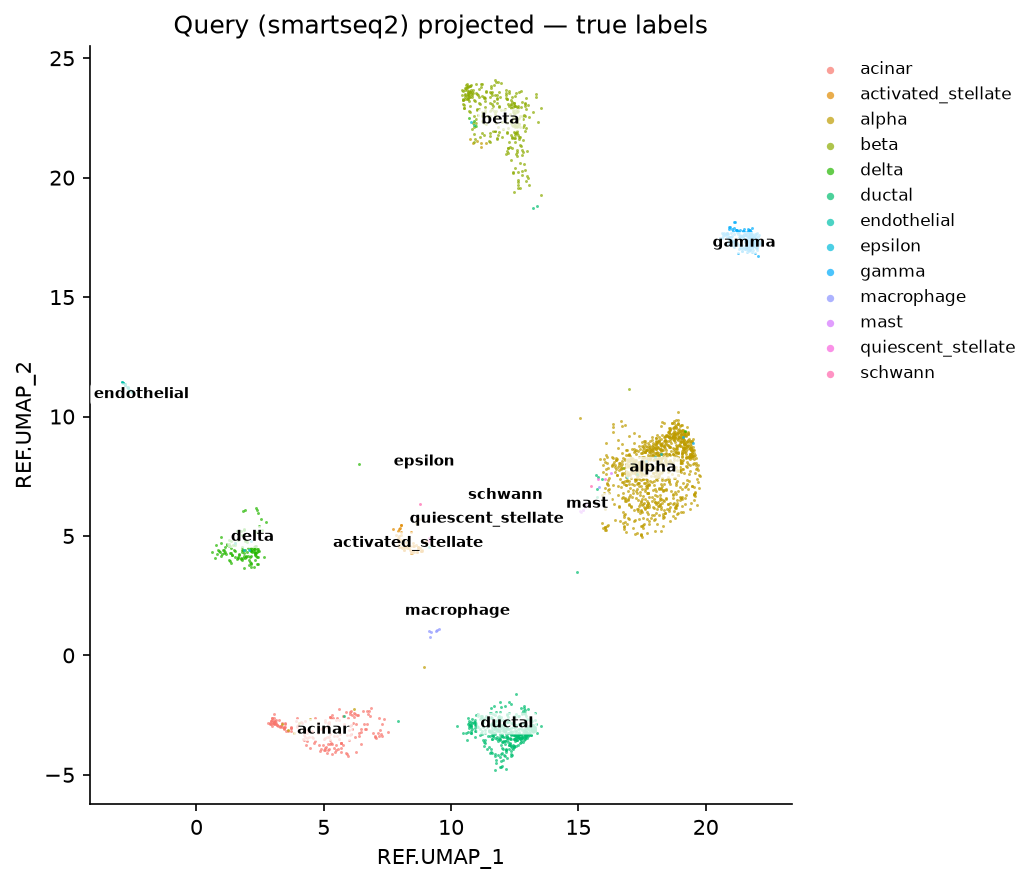 |
The headline · R-vs-Python concordance
Because the transferred labels are directly comparable per cell — both tools pick
a predicted.id from the same reference label set — the concordance is a plain
per-cell label agreement, alongside each tool's accuracy against the known
celltype. All computed from Seurat's predicted.id in the verify script's
r_calls.csv.
| tool | accuracy vs truth ↑ | mean score |
|---|---|---|
| truecell | 0.9862 | 0.9879 |
| Seurat R | 0.9875 | 0.9883 |
Label concordance — same
predicted.idper cell: 0.9887 (2,367 / 2,394 query cells).
truecell and Seurat annotate the query almost identically. 2,367 of 2,394 query cells (98.87%) receive the same label from both tools, and each tool is ~98.7% accurate against the held-out truth — truecell 0.9862, Seurat 0.9875, a 0.1-point gap that is entirely the rare-type tail where a few cells tip between neighbours. The two tools even fail together: both recover epsilon poorly, both nearly perfect on the abundant types. This is the confirmation the initiative was built to get — the reference-mapping stack, previously checked only on a synthetic two-type fixture, reproduces Seurat's annotation on a real thirteen-type cross-technology atlas.
No defect found. Unlike the integration tutorial — where the first real Seurat
comparison turned up a crash and a 4× under-integration in the RPCA path — the
transfer stack ports faithfully. That is the other outcome the R-fidelity net can
return, and worth stating plainly: find_transfer_anchors, transfer_data,
map_query and project_umap are confirmed against real Seurat on their first
real-data benchmark.
Running it yourself
Rscript tutorials/export_seuratdata.R panc8            # one-time counts export (~117 MB SeuratData pkg)
python  tutorials/panc8_reference_mapping_tutorial.py  # writes HVGs, prints accuracy + per-class recall
Rscript tutorials/panc8_reference_mapping_verify.R     # Seurat reference → r_calls.csv + r_*.png
python  tutorials/panc8_reference_mapping_tutorial.py  # re-run → prints the R-vs-Python concordance
python  tutorials/generate_refmap_plots.py             # Truecell figures → figures_refmap/py_*.png
Figures (tutorials/figures_refmap/, r_* = R Seurat, py_* = Truecell):
| Figure | Description |
|---|---|
py_01_reference_umap_celltype.png |
The reference atlas UMAP, by cell type — the space the query maps into |
py_02_query_projected_predicted.png |
The query projected into the reference UMAP, by transferred label |
py_03_query_projected_truth.png |
The same projection, by the held-out true label |
py_04_perclass_recall.png |
Per-cell-type transfer recall vs support — where it works, where it is noisy |
R Seurat → Truecell API
| Task | R (Seurat) | Python (Truecell) |
|---|---|---|
| Transfer anchors | FindTransferAnchors(reference, query, reduction="pcaproject", dims=1:30) |
find_transfer_anchors(reference, query, reduction="pcaproject", dims=30) |
| Transfer labels | TransferData(anchors, refdata=reference$celltype) |
transfer_data(anchors, refdata="celltype") |
| Impute expression | TransferData(anchors, refdata=GetAssayData(reference)[genes, ]) |
transfer_data(anchors, refdata=ref_expr, refdata_features=genes) |
| Project into reference UMAP | ProjectUMAP(query, reference, reduction.model="umap") |
project_umap(query, reference) |
| Map query (annotate + place) | MapQuery(anchors, query, reference, refdata=list(id="celltype")) |
map_query(anchors, refdata="celltype") |
| CCA transfer space (cross-modality) | FindTransferAnchors(..., reduction="cca") |
find_transfer_anchors(..., reduction="cca") |
References
Baron M, Veres A, Wolock SL, et al. (2016) A single-cell transcriptomic map of the human and mouse pancreas reveals inter- and intra-cell population structure. Cell Systems 3, 346-360. https://doi.org/10.1016/j.cels.2016.08.011
Stuart T, Butler A, Hoffman P, et al. (2019) Comprehensive integration of single-cell data. Cell 177, 1888-1902. https://doi.org/10.1016/j.cell.2019.05.031